"Thanks
again for introducing my son to the world of Martial Art..."
Caroline (Solicitor)
What is Martial Art:
 Recently
Martial Art has become associated with self-defence or fitness,
however, traditional Martial Art is a slow thorough process, which
improves physical coordination, mental focus and has a host of other profound benefits. Recently
Martial Art has become associated with self-defence or fitness,
however, traditional Martial Art is a slow thorough process, which
improves physical coordination, mental focus and has a host of other profound benefits.
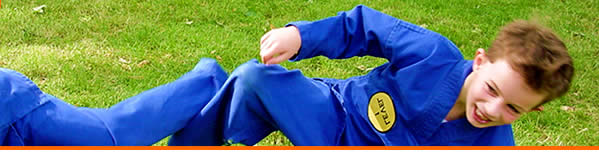
What we teach is unique and has been formulated specifically
to encourage these qualities in children.
Our syllabus is predominantly based on Ju Jitsu (the forerunner of Judo)
and Fanchento Kung Fu.
For more information please see www.fanchento.com.
We also draw on a host of other systems see below.
Training is varied and includes:
routines/ forms, grappling, throws, strengthening and coordination exercises, and discussions all specifically adapted for children.
The Instructor
 Eddie Edelstein has been teaching and practising martial arts for over 20 years. He has studied to some depth Karate, Wing Chun, Fanchento, Ju Jitsu and Tai Chi. Eddie Edelstein has been teaching and practising martial arts for over 20 years. He has studied to some depth Karate, Wing Chun, Fanchento, Ju Jitsu and Tai Chi.
He began when studying business and law in South Africa and after graduating and after working in the legal field for a year he chose to follow his passion and teach full time.
In 1996 he began teaching individuals and small groups of children. He selected developed and refined a range of techniques and exercises that proved very beneficial for younger students.
In 2001 he began teaching extensively in schools. With the invaluable input of child psychologists, occupational therapists and educators, his process of teaching to larger classes was refined.
Eddie is CRB checked and fully insured.
Our teaching strategy follows these steps:
-
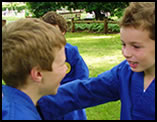 First
a routine is practiced solo (without a partner) but together
as a group. All pupils have a chance to lead the exercise and
this develops confidence and leadership skills. First
a routine is practiced solo (without a partner) but together
as a group. All pupils have a chance to lead the exercise and
this develops confidence and leadership skills.
-
Once the children have been able to work through the form as a group,
individuals begin to practise the separate elements of the form
with a cooperative partner.
-
The separate elements are then linked and practised as a single
sequence with a cooperating partner in a slow and safe way.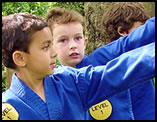
-
In the last stage, the formality of the routine is abandoned
and the technique is practised with a resisting partner or partners in
a variety of fluid and non-formal ways.
-
As the group’s discipline grows, so increasing complexity
and depth is introduced to practice.
Following these steps, children learn to be patient in acquiring
knowledge. In a slow and steady way they arrive at an understanding
of the sequence which allows them to enjoy and explore the creative
ways it can be executed.
Appropriate Training for Different Age Groups
 As children grow, they pass through various psycho-physical stages of development. For training to be most beneficial, these stages of development should be supported by the types of exercises engaged in. As children grow, they pass through various psycho-physical stages of development. For training to be most beneficial, these stages of development should be supported by the types of exercises engaged in.
At a young age, children love to roll and grapple with one another. It is a stage 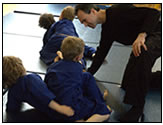 where gross motor coordination is developed and children have endless joy and enthusiasm for movement. During this stage our training focuses on grappling games and various types of rolling and falling, as this type of training supports this phase. where gross motor coordination is developed and children have endless joy and enthusiasm for movement. During this stage our training focuses on grappling games and various types of rolling and falling, as this type of training supports this phase.
At a later age (around 8 years old) children become fascinated with the world and how it works; they may start taking mechanical objects apart. At this stage we introduce locks and holds as a way of exploring the mechanics of the human body. Children find this aspect of training mentally stimulating.
At a later stage (around 12) children begin, like adults, to be far less comfortable with close physical contact. So, at this stage we move away from our focus on grappling (during which a high level of gross motor coordination was developed) to striking. Children continue to engage in "play" with  one another. one another.
During the later teenage years a deeper appreciation of martial arts develops and practitioners may begin to investigate the strategic and philosophical aspects that underpin true Martial Art training.
In developing our unique system, we drew on a range of other martial arts and so training in MAE is a wonderful way of introducing children to a variety of other systems.
Martial Art Systems we draw on
Ju Jitsu
Judo
Aikido
Karate
Tae Kwon Do
Kung Fu
Tai Chi
Kick Boxing
Jeet Kune Do
|