header
header


"I believe that Martial Art has helped develop Nathaniel's discipline determination,

focus and articulation, and I know a great deal of fun is had in the process"

Sarah (Ballet teacher)


demo classes
Autumn 2009 Time Table

Martial Art is a safe, healthy and fun way for girls and boys to develop:

Leadership
Enthusiasm
&
Calmness

In over 10 years we have refined a unique teaching method, which develops coordination, fitness, robustness, self-control and enthusiasm.

Girls and boys of all aptitudes and personalities show great enthusiasm for training because of the very simple step-by-step programme we follow and broad range of exercises we draw on. Parents and teachers have also commented on the positive effects of training and how much children enjoy it.


Physical Benefits of Training for Children


Coordination for Children:


Gross motor coordination refers to the large muscle groups of the body, and the coordination between them. This allows efficient large body movements like walking and running.

Gross motor coordination is necessary for us to carry ourselves with ease and confidence in the world, and is fundamental to fine motor coordination, necessary for skills such as writing neatly. This is why children who are not steady on their feet very often have poor handwriting.

One can develop gross motor coordination at any age, but the human body is “hard wired” to develop this during early childhood.

We use specially designed exercises to develop gross motor coordination to a very high level.

Balance for Children:


balanceA prerequisite for good balance is strength. Once a child is confident that one leg can support him easily, we develop balance further through an array of increasingly challenging exercises, interesting postures and games.

In addition to needing strength, balance is also greatly enhanced by focus and an awareness of one's body.

Strength for Children:


Strength is vital to balance and a range of other strengthskills and so we give this high priority..

Developing strength is a psycho-physical process which is facilitated by allowing the child permission to give 100% of energy using all the muscles of the body.

Therapeutic Benefits for Children:


special needsOur syllabus was developed with the assistance of a child psychologist and an occupational therapist. After many years of teaching this system we have found that training has improved coordination, orientation, spatial awareness and posture, as well as addressing dyspraxia. In addition it can improve a whole range of non physical issues.

The system naturally focuses on movement in relation to the centre line, orientating to the cardinal directions, up and down, left and right, and sensitivity to the presence of another person.


Stamina & Fitness for Children:


physical exertionOur classes end with exercises that are physically demanding and also enormously fun. This allows children to develop stamina and fitness through an immensely enjoyable process.

This is very important as, unlike in other cultures, this is one of the few arenas where children have an opportunity to learn that it is safe and healthy to break into a sweat.


Its not unknown for a beginner to approach the instructor to report that he would like to take a break not because he is tired but because he is sweating - a completely new experience!

Positive associations with physical exercise have a lifetime's benefit.


Robustness for Children:


robustRobustness is the ability to absorb minor knocks and bumps without being unduly concerned and upset by this. Initially many children report even the robust childrenmost minor concerns but following our carefully graded programme, after a short while they become very strong. Parents report their children are happy to "rough house" with others many years older than they are.

After three years of training our pupils are able to fall, roll and grapple with enthusiasm, and without complaining of injuries or slights.

Emotional Benefits


Confidence for Children:


confidence for childrenAll our training takes place in a firm framework and this allows children the certainty of knowing exactly where they should be and what they should be doing.

This combined with the tangible growth in their skills, strength, stamina, organisation and focus develops a real and noteworthy confidence.

Enthusiasm & Discipline for Children:


enthusiastic disciplined kidsOur exercises are natural and highly enjoyable for children. During practice their smiles and laughter speak volumes of their enjoyment.

However, we practise in a firm teaching framework producing a unique experience for children, melding enthusiasm and discipline.


Calmness for Children:


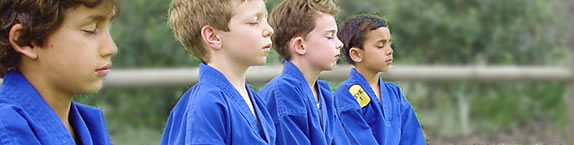
calm children kidsEvery class begins and ends with Mokso or stillness. Children centred childrenbecome aware of the difficulty in remaining still. This awareness is the first step in developing calmness.

The next step in developing calmness is practising exciting exercises within a firm teaching frame; this encourages children to stay aware of their emotional state and eventually take responsibility themselves to refrain from over-excitement.

At the most advanced levels, students are able to remain centred, focused and in control whilst being "attacked" by multiple opponents.


Focus & Attention for Children:


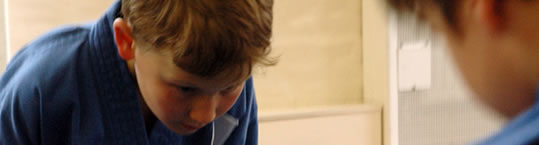
focused kidsChildren experience that paying close attention to their technique leads to accelerated progress. This deep focus of attention permeates their other activities and is demonstrated in their poise and alertness.


Self Esteem for Children:


Every element of a technique or exercise is individually and thoroughly practiced before the next aspect is introduced. We have developed an self esteem kidsarray of strategies to ensure this remains challenging and interesting.


Following this methodology, the skills we develop become an internalised part of our students’ “body wisdom” or reflex that is always available and not reliant on mental recall.


Over many years of teaching in schools, our programme has been proven to guarantee remarkable growth in skill and strength; of which students are justifiably proud. We recognise and reinforce this experience with a variety of badges, stickers and awards, but believe the experience in itself is primarily responsible for our students’ high self esteem.

Social Benefits for Children


Leadership Skills for Children:


leadership childrenAn important part of our programme is for all students to lead certain exercises.

Shy children are given a great deal of support and, because they know the exercises so well, they become confident and even excited to lead.

The responsibility of leading an exercise is a powerful experience for children and although initially often overcome with giggles they quickly take their responsibility very seriously.


Healthy Conflict Resolution for Children:


conflict resolution for childrenIn all group activities for children, especially physical ones, there are likely to be squabbles.

Over many years we have devised efficient routines that allow both parties to understand what has caused a misunderstanding, to empathise with the other's position and then return to training.

In the unusual case where children really cannot get on well together they train in separate groups or with other partners.


Prevents Bullying for Children:


deal with bullyingConfident children with good communication skills are far less likely to be identifieddeal with bully by bullies as potential victims. They are also far less likely to resort to bullying themselves because they are able to express themselves clearly and are more powerful in the world.

The techniques we teach can eventually be used in a very powerful way for self defence, but our policy is that martial art should not be used as a method to harm others. With the correct attitude and bearing, conflict can be avoided.


Teamwork for Children:


teamworkThe majority of our training occurs in teams or with partners.

Children experience the pleasure and the accelerated growth of training in a cooperative rather than competitive environment.

The idea of working in a cooperative way with one's partner informs every aspect of training and its importance is often referred to in our group conversations.


Improves Children's Ability to Relate to Others:


empathyIt is difficult to communicate the idea of empathy to children.

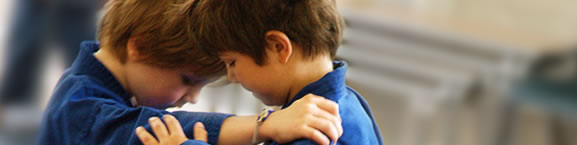
However, through our programme children do develop gentleness. For example, when practising throws, students always make a point of supporting their partner.

This is because, through physical training, students experience directly what their classmates do and this experience is highlighted in class discussions.

Children begin to care for their training partners and class mates.


Communication Skills for Children:


children communicationTraining occurs primarily through the body, requiring a very high level of cooperation to develop techniques which are practical, fluid and graceful.

The process of developing this physical cooperation naturally encourages mature communication and this process is enhanced by both the class structure (which is open enough to encourage communication but not so free as to allow for disruptions) and group discussions.


Respect for Children:


respectful childrenRespect in Japanese is Rei which is used as an instruction to bow. This is not a religious act but an indication of respect.

We maintain this practice of "greeting" our partner before and after working with him/her because it encourages students to begin practice in a mindful and controlled manner.

We believe that true respect cannot be engendered by enforcing these rules of etiquette but rather is developed through empathetic practice with the desire to learn and help others learn.


Friendship for Children:


children friendshipOne of the most important aspects of training in martial art is the deep friendships that form; often these friendships last a lifetime.

Often play dates and after-training dinners are arranged amongst parents.

If children change schools or face other potentially traumatic upheavals, training provides a space where they can maintain a sense of continuity in terms of learning, growth and social interaction.